
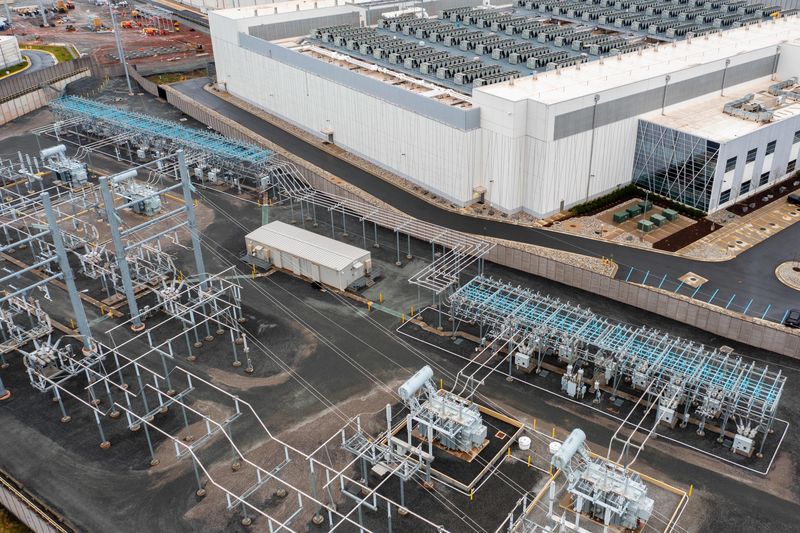
A company announces plans to invest billions of dollars building a new data center in your community or state. The project promises economic growth, construction jobs, new tax revenue, and infrastructure to support the technology businesses and consumers increasingly depend on.
Local officials welcome the investment. The developer begins planning its facility. Utility companies begin assessing whether the electric grid can supply the enormous amount of power the project will require.
Then the questions emerge. What happens if the existing grid cannot deliver that power without major upgrades? Who pays to build the new transmission lines, substations, and other infrastructure needed to serve the project?
And if the cost of expanding the grid ultimately affects electricity rates, could households and small businesses end up footing part of the bill?
These are not hypothetical questions. Across the country, utilities, regulators, grid operators, technology companies, and consumer advocates are debating how to accommodate rapidly growing electricity demand without unfairly shifting the costs to existing customers.
At the heart of the debate is a straightforward question:
When a private company's growth creates a need for new electricity infrastructure, how much of that cost should the company pay—and how much, if any, should be shared with you, and I and other customers?
First, Let's Understand What We're Paying For
Before deciding who should pay, it helps to understand what expanding the electric grid actually involves.
Electricity does not travel directly from a power plant to your home through one wire. It moves through a connected system of generation resources, high-voltage transmission lines, substations, distribution networks, and other equipment that delivers electricity where it is needed.
When electricity demand increases significantly in a particular location, the existing infrastructure may not have enough capacity to serve it reliably. A new or expanding data center could require a dedicated connection, a new substation, upgrades to existing transmission facilities, additional generation, or some combination of these investments. The requirements depend on the facility's size, location, timing, operating profile, and the capacity already available. These improvements can be expensive, and some take years to plan, approve, and construct.
Here's an important distinction: when we refer to the public electric grid, we're talking about infrastructure that serves a wider electricity system and is subject to various public regulations. We are not necessarily talking about infrastructure owned by taxpayers. Many transmission and distribution assets are owned by investor-owned utilities, municipal utilities, or electric cooperatives. The way those assets are owned, regulated, and financed affects how their costs are recovered.
The real issue is not simply who owns the grid. It is how the costs of expanding it are assigned to the people and businesses that create the need for it or benefit most from the investment.
The Principle of Fair Cost Allocation
Let's consider two situations. In the first, a company needs a new electrical connection built specifically to serve its facility. That connection would not otherwise be necessary. In the second, a utility upgrades a major transmission corridor. The work is needed partly because of the new company's demand, but it also improves reliability or creates capacity that can benefit other customers.
Should the company pay for both projects in their entirety? Not necessarily.
The first situation presents a strong case for assigning the direct costs of the dedicated connection to the company that requires it. In the second, the appropriate allocation depends on the causes of the investment, the benefits it delivers, applicable regulations, and the arrangements under which the grid is financed.
A useful starting principle is this: Costs should be assigned transparently, in a way that reflects who causes the need for an investment, who benefits from it, and who has agreed to bear the risk. This does not mean every upgrade must be paid for by one company. It means the reasons for assigning costs to that company, its utility, other customers, or a broader group of beneficiaries should be clear and defensible. Without that clarity, it becomes difficult for the public to know whether an arrangement is fair.
The Concern: What If Other Customers End Up Paying?
Electric utilities often recover approved infrastructure costs through regulated rates and charges. Depending on the utility structure and applicable rules, those costs may be allocated among different classes of customers, including residential, commercial, and industrial customers. When a major new electricity user triggers an infrastructure investment, the way those costs are allocated matters.
Suppose a utility builds expensive transmission infrastructure in anticipation of a large data center. If the project is delayed, substantially reduced, or canceled, the utility may still have costs associated with the facilities already built or committed.
Who is responsible for those costs? The answer depends on the applicable tariffs, agreements, regulatory decisions, and financial protections.
If the arrangements do not adequately protect against that risk, some costs could potentially be recovered through charges affecting other customers. But it would be incorrect to assume that every new data center automatically raises household electricity bills. The outcome depends on the project's circumstances and how the costs are handled.
This is why consumer advocates and regulators are asking for better information about infrastructure costs, stronger financial commitments from large electricity users, and clearer rules for recovering costs when projects do not proceed as expected.
A company should be able to plan for growth. Utilities should be able to invest in infrastructure. And existing customers deserve protection against costs and risks that have not been adequately considered. All three objectives matter.
Virginia: A Case Study in Who Pays
The Virginia State Corporation Commission (SCC) issued its decision on July 31, 2026, establishing a framework that requires Dominion Energy to revise its policies so that large-load customers pay for certain transmission facilities built specifically to connect them to the grid. The commission also adjusted how transmission costs are allocated among customer classes.
Here are the key developments:
Directly connected transmission infrastructure - Data centers will be required to contribute toward the cost of substations and transmission lines that would not have been built without their electricity demand.
Residential bill impacts - Dominion's proposed Rider T-1 increase for a typical household using 1,000 kWh per month was initially estimated at $2.90 monthly. After updated calculations and other approved changes, the projected increase fell to $0.94 monthly. These are projections, not a measure of the total long-term cost of data centers to households.
The issue is not fully resolved - Broader transmission network upgrades still raise questions about which costs should be assigned to individual data centers and which should be shared across customer classes. Microsoft filed a notice preserving its ability to appeal the decision.
You can read the original reporting from Utility Dive on Microsoft's potential appeal.
Texas: Planning for a Surge in Electricity Demand
Texas faces its own challenges. The Electric Reliability Council of Texas, or ERCOT, operates the grid that serves most of the state. As large data centers and other electricity-intensive facilities seek grid connections, ERCOT must then assess the combined demand and determine what the system can reliably accommodate.
In June 2026, the Public Utility Commission of Texas (PUCT) approved ERCOT's Batch Zero process for qualifying large electricity users requiring at least 75 megawatts. Under this new process, qualifying projects are studied together so ERCOT can assess projected demand, available grid capacity, and needed transmission upgrades. The process helps Texas evaluate the broader system implications of a surge in large-load requests.
It is important to understand what this does—and does not—accomplish. A coordinated study process helps identify demand and infrastructure requirements. It does not, by itself, settle every question about who ultimately pays for each upgrade or how costs flow through electricity rates.
Those are related but separate questions. For Texans, both matter: the grid must be able to serve new demand reliably, and the financial arrangements for meeting that demand must be transparent.
Source: ERCOT — PUCT approves Batch Zero process for large electricity users, June 18, 2026.
Why This Matters Beyond Virginia and Texas
This debate reaches beyond utility bills because it affects how states evaluate economic development incentives, infrastructure planning, community impacts, and the distribution of costs and benefits.
A data center may deliver substantial local tax revenue while its electricity infrastructure costs are recovered across a much broader population. Those are separate financial questions, and both need to be considered when evaluating the project's overall economic impact.
For communities, the important questions include:
Those questions are particularly relevant in communities that may experience increased pressure on electricity, water, land, and other public resources without receiving an equivalent share of the economic benefits.
Federal Regulators Are Asking Questions, Too
The debate on these issues also extends beyond Virginia and Texas. On June 18, 2026, the Federal Energy Regulatory Commission (FERC) issued show-cause orders to six regional transmission organizations and independent system operators concerning how large electricity users connect to the transmission system.
The orders address issues including the transparency of transmission-upgrade costs, the potential for costs to shift among customers, and financial protections when a large-load project is canceled or leaves the system. These proceedings are significant, but an important distinction matters: the orders initiated a process requiring regional grid operators to justify their existing rules or propose reforms. They did not, by themselves, establish a final national cost-allocation formula.
FERC is examining how transmission rules can better accommodate large electricity users while addressing reliability, transparency, and consumer-protection concerns. The underlying question is the same one communities are asking: how can the electricity system support economic growth without leaving customers exposed to costs they did not reasonably anticipate?
The Strongest Arguments for Making Data Centers Pay
The underlying principle is known as cost causation: customers should generally bear the costs their electricity use creates. Consider three examples.
A. Infrastructure built exclusively for one data center - If a new facility requires a dedicated substation and transmission line that would not otherwise exist, regulators can identify a relatively direct connection between the customer and the cost.
Policy question: Should that customer fund the infrastructure rather than spreading the expense among households and small businesses?
B. Regional transmission upgrades - A new data center may trigger improvements to a larger network that also serves existing communities and other businesses.
Policy question: What proportion of the cost is attributable to the data center, and what proportion benefits the wider grid?
C. Infrastructure built for uncertain future demand - Utilities sometimes invest in advance of a project's completion or before all proposed data centers are operational.
Policy question: Who pays if a developer cancels, scales back, or delays its project after the utility has committed billions of dollars?
In Virginia, regulators and consumer advocates have raised concerns about residential and small-business customers subsidizing infrastructure associated with large electricity users. Industry representatives, meanwhile, have questioned whether the existing evidence and cost-allocation rules justify every proposed change.
What are the arguments against assigning all transmission costs to data centers?
A workable policy needs to address the other side of the issue, too.
These considerations do not eliminate the cost-allocation question. They explain why regulators must distinguish dedicated facilities from broader network investments rather than apply one blanket rule to every transmission project.
But What About the Economic Benefits?
Supporters of large industrial projects and data centers raise an important counterargument. Major developments can attract substantial private investment, create construction and operating jobs, generate tax revenue, support local businesses, and strengthen the economy. Grid infrastructure may also deliver benefits beyond the original project by improving reliability or making additional development possible.
Those benefits should not be overlooked. A policy that assigns every dollar of every grid improvement to the first company that triggers a need could discourage worthwhile investments or require one customer to pay for infrastructure that ultimately benefits many other users.
On the other hand, allowing a large customer to use the grid without adequately accounting for the costs and risks it creates could leave other customers carrying an unfair share of the burden.
Neither extreme provides an automatic answer. The goal should be to understand the full agreement: the private investment, the infrastructure required, the public incentives offered, the benefits to other customers, and the commitments that protect against unexpected costs.
A company should not be judged solely by how much electricity it uses. A project should be evaluated on the costs it creates, the benefits it provides, and the terms under which it is served.
What Would a Fair Arrangement Look Like?
I don’t know of a single formula that fits every grid investment, and I certainly don’t have the answer. However, here are several principles that I would suggest can guide a more transparent and accountable process.
First, identify the costs. Regulators, utilities, and grid operators should provide enough information for the public to understand which upgrades are required, why they are needed, and what they are expected to cost.
Second, distinguish dedicated facilities from broader system improvements. Infrastructure built specifically for one large user should be evaluated differently from investments that also provide material benefits to the wider grid.
Third, establish financial commitments before major investments are made. Depending on the project and regulatory framework, minimum-payment obligations, deposits, collateral, long-term service commitments, or cost-recovery agreements may help protect other customers if a project changes or fails to materialize.
Fourth, make cost allocation understandable. People should be able to see how costs are assigned and how those decisions affect customer groups, even when the technical details are complex.
Finally, review the results. Forecasts do not always match reality. If a facility consumes less power than expected, an upgrade benefits a much wider area than originally anticipated, or project conditions change, the relevant agreements and cost assignments should be examined under the applicable rules.
These principles do not require every company to pay for the entire grid. They require a transparent explanation of why each party is paying its share.
Questions Worth Asking Before the Grid Expands
Whether a proposed development is a data center, manufacturing facility, or another large electricity user, residents, small businesses, and public officials can and should ask:
Perhaps these questions can help move the discussion away from assumptions and toward verifiable information.
THE BOTTOM LINE
My view of the underlying issue is that the cost of expanding the electric grid to serve large load users and data centers should be allocated in a way that reflects who creates the need for that expansion, rather than automatically shifting those costs to ordinary electricity customers.
Growth is a shared opportunity. Paying for it requires accountability. The electric grid must evolve as the economy changes. New technologies, manufacturing, transportation, and digital services will continue to influence where electricity is needed and how much infrastructure the system requires.
Investment in infrastructure is not inherently a problem. Nor is a large company's need for more electricity automatically evidence that other customers will be harmed. This is a question of cost responsibility, economic development, and fairness.
Data centers can bring billions of dollars in investment, tax revenue, and jobs. But they can also create enormous new electricity demand that requires utilities to build transmission lines, substations, and other infrastructure.
The challenge is determining how to accommodate growth while assigning costs and risks in a way that is transparent, defensible, and consistent with the benefits received.
Private companies should be able to pursue investment and expansion. Utilities should be able to build the infrastructure needed to serve customers. Regulators should have the information and authority necessary to evaluate cost allocation and protect consumers. And the public should be able to understand the decisions that may affect its electricity bills.
The question is not whether a company should be allowed to grow. The question is whether the costs of that growth are being assigned fairly—and whether the public can see, understand, and hold the responsible parties accountable for the arrangement.
Because when the grid expands to support economic growth, the cost of that growth should never be treated as an afterthought.
And that’s real talk. That’s keeping it 100.
Power Unfiltered
Clean Energy. Real Talk.
Follow us. Ask questions. Join the conversation.
Explore more explainers and community-focused reporting at Power Unfiltered.
Like this briefing? Get The Quiet Storm in your inbox every Tuesday. Subscribe to The Quiet Storm
© 2026 Power Unfiltered. All rights reserved. Content reuse and licensing
Join the discussion
0 commentsComments are read and approved before they appear. Disagree all you like — keep it about the argument.
No comments yet. Ask the first question.