
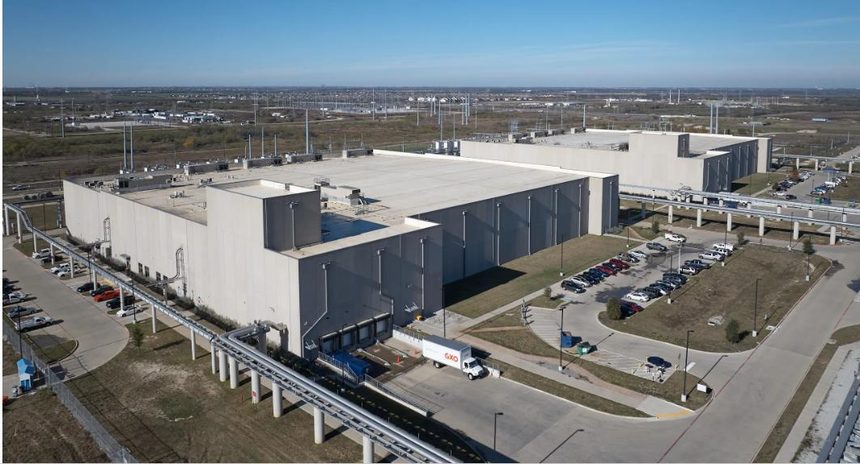
You may have heard that a new data center is coming to your area. Maybe you've seen a news story about a multibillion-dollar technology project. Maybe you've heard that artificial intelligence is driving demand for more computing power. Or maybe you've simply heard someone say: Data centers are using too much electricity. And then comes the questions:
Let's break it down piece by piece to make it a bit easier to understand.
First: What exactly is a Data Center? At its simplest, a data center is a facility designed to house large amounts of computer equipment and the systems needed to keep that equipment operating. For all the OG’s (Old Guys) out there, you may recall back in the late 1990s early 2000s, these data centers were multi-tenant facilities called “Co-Location” averaging 10,000 – 20,000 square feet.
Today’s hyperscale facilities are highly specialized buildings regularly exceeding 1 million square feet and filled with:
The computers inside a data center process, store and move enormous amounts of digital information. They support things many of us use every day:
And much more.
The computers may be digital, but the energy they require is very real.
HERE'S THE CONNECTION TO ENERGY
A data center is primarily an electricity consumer. Remember the three-part framework we identified from our earlier Power Unfiltered articles:
Generation ----- Makes electricity.
Storage ----- Stores electricity for later use.
Demand ----- Consumes electricity.
A solar farm is generation. A BESS facility is storage. A data center is demand. And increasingly, very large demand.
The U.S. Energy Information Administration (EIA) says data-center development is one of the major drivers behind the current growth in U.S. electricity consumption. The EIA forecasts U.S. electricity sales to increase by almost 2% in 2026 and another 2% in 2027, with data-center development and manufacturing activity contributing significantly to commercial and industrial growth. That's why data centers have become a highly controversial energy story.
WHY ARE DATA CENTERS GROWING SO QUICKLY?
Data center interconnection is often framed as a choice between grid reliability and economic growth. One of the biggest reasons is the rapidly increasing demand for computing. Artificial intelligence is an important part of that growth. AI systems require powerful computer chips and large quantities of computing capacity. Those chips consume electricity—and they generate heat that has to be managed.
The U.S. Department of Energy (DOE) describes large AI-oriented data centers as a growing and increasingly dynamic class of electricity loads. Meanwhile, cloud computing and digital services continue to require large-scale computing infrastructure.
The result is straightforward: More computing = more servers = more electricity demand. And the scale is significant.
THE NUMBER YOU SHOULD KNOW
11.8%
Lawrence Berkeley National Laboratory's 2025 update to its U.S. Data Center Energy Usage Report estimates that data centers could account for 11.8% of total U.S. electricity use by 2030 in its reference case. The report's scenarios range from 9.5% to 15.3%, reflecting uncertainty about future equipment deployment, utilization, efficiency and other factors.
That's a forecast—not a guarantee. But it illustrates why data centers have moved from being primarily a technology story to being a major electricity and infrastructure story.
WHY DOES A DATA CENTER NEED SO MUCH ELECTRICITY?
The computers themselves use electricity. But that's only part of the story. Data centers also need electricity for:
And cooling can be a major part of the energy equation. Berkeley Lab estimates that cooling requirements in data-center space can be substantially more energy-intensive than cooling in other commercial building space. Why? Because the computers are constantly producing heat. Here's an easy way to think about it: Electricity goes in. Computing happens. Heat comes out. That heat has to be managed continuously.
SO WHY BUILD THEM HERE?
This is one of the first questions communities should ask when a data center is proposed. A data center cannot simply be placed anywhere there is available land. It also need:
The DOE notes that data centers can have significant regional grid impacts because of their large load sizes and that their locations can be constrained by factors such as network capacity. So, if a developer is interested in a particular location, one of the first questions should be: Why here?
WHAT DOES THIS HAVE TO DO WITH THE GRID?
Quite a lot actually. The Lawrence Berkeley National Laboratory predicted that data center demand will grow from 176 terawatt hours (TWh) in 2023 (or, about 4.4% of total U.S. electricity consumption) to between 325-580 TWh (6.7-12.0%) by 2028. In some parts of the country, AI-driven energy demand is already outpacing available capacity.
In Texas, the Dallas-Fort Worth area has emerged as one of the largest data center markets in the United States and is continuing to witness massive build out. ERCOT projects that peak summer power demand could approach 145 GW by 2031, up from 85 GW in 2024; this represents a significant acceleration relative to the gradual 1-2% annual growth in demand experienced over the past two decades. Over half of this new demand (about 32 GW) is projected to come from data centers.
So, what does this have to do with the grid? The electric grid has to maintain a balance between electricity supply and demand. When a very large customer wants to connect, grid operators and utilities have to determine whether the existing grid can accommodate that load---and what upgrades may be necessary to facilitate it.
Texas is dealing with this issue right now. ERCOT has seen an influx of newly proposed large electricity users like data centers and is struggling to assess how much water these facilities will use. They recently began asking some important questions from potential developers and has issued a request for information (RFI) from all developers of data centers 25 MW or more pursuing interconnection to the ERCOT System. A deadline in October was established for developers to respond, and a report of their findings is expected to be published this December 2026.
Their questions cover:
Developers that do not complete the survey will be reported to the Public Utility Commission of Texas (PUCT) and the governor’s office and will be evaluated on a case-by-case basis.
Nationally, the U.S. grid is flooded with data center proposals that will never get built. That makes it very difficult for utilities and grid operators to plan for the future. Maybe you've heard about the proposed Tesla and SpaceX 100 million square feet megafactory in Texas that is expected to rely largely on the grid. Will it ever be built? How would it impact the grid?
Conservative estimates suggest that five to 10 times more interconnection requests are made than data centers will actually be built. That distinction matters. A request is not the same thing as a project. A proposed project may never be built. A project may be delayed. A project may be downsized. A project may not receive approval to connect.
That's why Power Unfiltered is careful to make the distinction between:
Those are very different things.
DOES A DATA CENTER RAISE MY ELECTRICITY BILL?
That’s the all-important question you've probably been waiting to ask. I feel you. And once again the answer is: It depends.
A large new electricity customer can create new demand for generation, transmission and distribution infrastructure. That infrastructure has costs. The important question is: Who pays those costs? The Department of Energy has specifically identified this as a policy issue, noting concerns about fairly allocating electricity-system costs to large-load customers and avoiding situations where costs are shifted unfairly to other customers.
So, the right question isn't: Will this data center raise my electric bill? The better questions are:
These questions can matter much more than the headline number attached to the data center investment.
WHAT ABOUT THE BENEFITS?
Let’s keep it 100. A major data center project can bring potential benefits. And may include:
But, and that's a big but, those benefits should be examined closely—not simply assumed. For example: A project may announce thousands of construction jobs.
Again, these are not necessarily anti-data center questions. They are reasonable questions that should be asked and answered.
WHAT ABOUT WATER?
This is another area where the conversation can become overly simplistic. Data centers require cooling. Depending on the cooling technology and site design, water use can vary significantly. Some facilities use cooling systems that rely heavily on water---lots of water. Others use different technologies, including systems designed to reduce or limit water consumption.
Lawrence Berkeley National Laboratory's data-center research examined both electricity and water consumption and noted that cooling-system choices are an important factor in overall resource use. So, when someone says: Data centers use huge amounts of water. Or, data centers don't use much water. The Power Unfiltered response:
These details matter. Keeping the main thing the main thing.
WHAT ABOUT THE ENVIRONMENT?
Again, we need context. Data centers can and will have environmental impacts associated with:
The impact of each project depends on how it is designed and operated. That's why a community shouldn't judge every data center by the same standard. Ask about the actual project.
WHAT ABOUT CLEAN ENERGY?
Here's where the discussion gets particularly interesting. A data center is an electricity consumer. But the electricity serving it can come from different sources. A project may rely on electricity from the grid. It may have some form of on-site generation. And we’ve all heard the alarming stories from community residents about air pollution from gas turbines used at these sites.
Data centers may also contract electricity from renewable resources. They may use battery storage or other technologies to increase flexibility. The DOE identifies on-site generation, storage, microgrids and other approaches as potential sources for helping meet large-load electricity demand while supporting grid reliability and flexibility.
So, the question isn't simply: Is this a data center? It is: How is this data center going to be powered?
CAN DATA CENTERS HELP THE ENERGY TRANSITION?
Potentially, yes. Large electricity customers can become part of the solution if their operations are designed to work constructively with the electric system. That could include:
The DOE has been exploring ways that large load users such as data centers can be integrated with the grid through technologies and operating approaches that improve flexibility and reliability. But again: Potential is not the same as performance. A community should ask what a specific project has actually committed to do---in writing.
AND WHAT ABOUT JOBS?
This is where we return to one of Power Unfiltered recurring questions: Who gets the opportunity?
A data-center project can involve workers in:
But a sophisticated facility may require specialized skills. So, if a community is being told: “This project will create jobs.” ask:
Those questions can turn a project from a headline into a workforce opportunity.
THE COMMUNITY IMPACT QUESTIONS
Before a major data center is built near your community, consider asking:
And perhaps the most important question Power Unfiltered wants to always ask and have answered: What does the community get in return?
THE REAL TALK
Community opposition is being driven by concerns over electricity demand, water consumption, noise, pollution, land use, utility costs, and environmental impact.
Power Unfiltered wants to be perfectly clear here: Our position is that data centers are not inherently good. And they are not inherently bad. They are large electricity-consuming facilities supporting an increasingly digital economy. They can bring:
But they can also create legitimate concerns and questions about:
The questions and information provided here isn’t meant to celebrate every project. And it isn't to oppose every project. It is intended to help you understand the project in front of you. No hype. No political spin. Full stop.
THE BOTTOM LINE
The computers inside a data center may be virtualizing businesses, storing information, running artificial intelligence and powering services we need and use every day.
But here’s the rub: the electricity powering those computers is very real. And data-center demand is becoming a very important part of the growth in U.S. electricity consumption. And the infrastructure needed to serve that demand is becoming an increasingly important part of the energy conversation. That means the questions surrounding data centers aren't just technology questions. They're questions that deserve serious conversations.
That's why Power Unfiltered is going to keep asking the relevant questions. And we’ll never tell you what to think. We’ll help you understand what's happening—and give you the information to ask better questions. Because when someone says: “We're building a data center in your community.” You shouldn't have to wonder: What does that mean for me? For my community? You should understand the conversation.
Don't panic. Don't blindly celebrate. Understand it.
And that’s just keeping it 100.
POWER UNFILTERED
Clean Energy. Real Talk.
Follow us. Ask questions. Join the conversation.
Join the discussion
0 commentsComments are read and approved before they appear. Disagree all you like — keep it about the argument.
No comments yet. Ask the first question.