
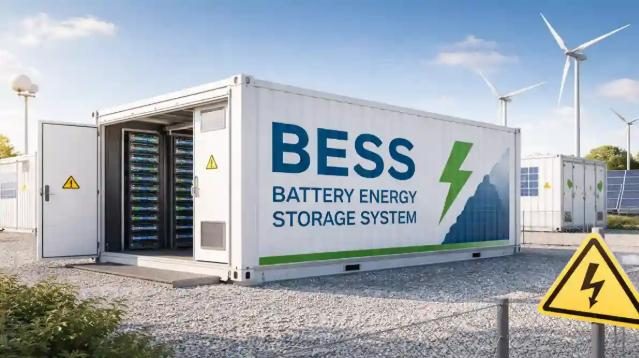
You may have noticed them. Rows of large containers sitting behind fences. A new energy project being proposed near a highway. A solar farm with a battery facility next to it.
Or perhaps a public meeting notice announcing a Battery Energy Storage System, commonly called a BESS, somewhere near your community. And if you're like many people, you may be wondering:
And perhaps the biggest question: Are they safe?
Let's take it one piece at a time.
First: What Is a BESS? BESS stands for Battery Energy Storage System. The simplest way to think about a BESS is: It's a very large rechargeable battery system designed to store electricity and make that electricity available later. That sounds simple because it is. But the systems used by utilities and developers can be much more sophisticated than the batteries in a cell phone or electric vehicle.
A BESS typically includes batteries along with equipment that manages, converts, monitors and protects the system. The batteries store energy. Power-conversion equipment moves electricity between the batteries and the electric grid. Control and monitoring systems manage charging, discharging, temperature, equipment status and other operating conditions. Safety systems are designed to detect and respond to abnormal conditions.
The result is not simply “a big battery.” It is an energy system designed to interact with the electric grid. This is one of the most important concepts in understanding BESS. A battery stores electricity that was generated somewhere else and releases that electricity later when needed. The U.S. Energy Information Administration (EIA) describes storage systems as secondary sources of electricity because they must first be charged using electricity from a generator or the grid.
Think of it like filling a gas or water tank. The tank doesn't create the gas or water. It stores it until you need it. A battery does something similar with electricity. Charge it. Store it. Discharge it when needed. That simple concept is at the heart of BESS.
So Why Do We Need Batteries?
Because electricity has to be available when people need it, not simply when it is being produced. Electricity supply and demand changes throughout the day. There may be times when more electricity is available than people are using.
There may also be times when demand rises, and the electric grid needs additional power quickly. Energy storage gives grid operators and other participants another tool for managing those changes.
The U.S. Department of Energy (DOE) describes storage as an important part of maintaining a reliable and balanced electric system by capturing energy when supply is high and releasing it when demand increases.
Here's a simple analogy: Imagine a sunny afternoon. Kids are in school. You’re busy at work and demand for electricity is at its lowest. Solar farms may be producing a lot of electricity. But electricity demand may not be at its highest point.
Instead of allowing some available electricity to go unused, a battery system can potentially charge during that period. Later, when everyone is home, electricity demand increases, the sun has gone down, and solar production declines, the battery can discharge electricity.
The battery hasn't created new electricity. It has only shifted when that electricity is available and needed. That's one of the reasons batteries are increasingly being paired with solar projects. EIA reports that co-location of battery storage with renewable generation has grown substantially in recent years.
What Else Can BESS Do?
Storage can perform several different functions. A battery system may be used to:
Why Are They Being Built in Communities?
This is where things become more complicated. A battery facility needs more than batteries. It needs:
And it needs to make economic and operational sense for the developer or owner. That's why you may see BESS facilities located near electrical substations, transmission infrastructure, solar generation or other areas where the system can efficiently connect to the grid.
The location is therefore about much more than finding an empty piece of land. The connection to the electric grid matters. The connection is the main thing.
Does a BESS Mean There Will Be More Electricity?
Not necessarily. Remember: BESS stores electricity. It does not create it. A battery may make electricity available at different times, provide grid-support services, or help balance supply and demand. But installing a battery doesn't automatically mean that your community now has a new source of electricity generation.
That's why it is important to ask: What is this particular BESS designed to do? The answer may be different from one project to another.
What Does a BESS Mean for Your Electricity Bill?
This is one of the questions people naturally ask. The answer is: It depends. A BESS can provide services that have value to the electric system, including shifting energy availability and supporting grid operations. But that does not automatically mean the battery project near your community will lower your household electricity bill.
Your electricity bill includes more than the cost of generating electricity. As we discussed in our first Power Unfiltered article, costs associated with generation, transmission, distribution and other charges can affect what customers ultimately pay. So, when someone says: “This battery project will reduce electricity costs,” ask:
And most importantly:
Those are better questions than simply asking whether batteries are “good” or “bad.”
What About Safety?
Now we get to the question that many communities understandably have:
The honest answer is that safety is a serious consideration with large battery energy storage systems, and it should be part of the project discussion from the beginning. Many utility-scale BESS installations use lithium-ion batteries. These batteries offer characteristics that make them useful for grid applications, including high efficiency and rapid response, but they also present specific safety considerations.
One concern is thermal runaway. In simple terms, thermal runaway is a situation in which a battery cell or group of cells experiences an uncontrolled increase in temperature that can lead to fire, gas generation and potentially propagation to other cells or equipment. Large battery systems contain substantial amounts of stored energy, so failures can present challenges for operators and first responders.
The EPA specifically identifies concerns involving lithium battery fires, emissions, cleanup and emergency response. That does not mean every BESS facility is going to experience a fire. It does mean that safety cannot and should not be treated as an afterthought.
So, What Should a Community Be Looking For?
One of the most important things a community can do is move the safety conversation from: “Don't worry. It's safe.” to “Show us how safety has been designed, tested and prepared for.”
Ask whether the project has appropriate safety measures, emergency procedures, monitoring, detection, fire protection and coordination with local responders. Industry standards and testing programs—including UL 9540 and UL 9540A—play a role in evaluating energy storage equipment and fire behavior. UL describes UL 9540 as a product safety standard for energy storage systems and UL 9540A as a large-scale fire test method used to evaluate fire characteristics of battery energy storage systems.
And communities should ask how local fire departments and emergency responders will be involved. The EPA recommends that communities work with BESS safety experts and local responders when planning installations and preparing for potential incidents.
What About the Environment?
Again, the answer requires more than a simple “yes” or “no.” BESS facilities have environmental considerations associated with:
If a battery is damaged during an incident, EPA notes that cleanup and disposal can require specialized procedures. That means environmental questions should be part of the conversation before a project is built, not only after something goes wrong.
And What About Jobs?
This is another area where communities should look beyond the headline. A BESS project may create jobs during:
But just as we discussed in the first article, construction employment and permanent employment are different. A project might require a large workforce to build and commission the facility and a much smaller workforce to operate it afterward. So ask:
Those questions turn a project announcement into a conversation about economic opportunity.
The Number You Should Know
Nearly 52 GW By the end of 2025, the United States had about 43.6 gigawatts of operational utility-scale battery storage capacity. During the first six months of 2026, operators added another 8.3 GW, bringing the total to nearly 52 GW based on the Energy Information Administration's preliminary data.
That number matters because it shows that battery storage is no longer a small experiment. It is becoming a significant part of the U.S. electric system. And as the technology scales, the quality of the conversations surrounding it matters just as much.
What Should You Ask Before a BESS Is Built Near You?
Here is your Power Unfiltered checklist:
Is it supporting renewable generation, balancing the grid, serving a particular customer, providing backup, or performing multiple functions?
Is proximity to a substation, transmission line or generation facility part of the reason?
And perhaps one of the most important questions to ask:
The Bottom Line
A BESS is not simply a field full of batteries. It is part of a larger electricity system. It can store electricity and make it available later. It can help balance supply and demand. It can support grid operations. It can work alongside renewable generation. And it can become an important part of how the electric system responds to changing demand and changing sources of electricity.
But communities should not stop at understanding what a BESS does. They should also understand:
Those aren't anti-energy questions. They're reasonable questions for any major infrastructure project.
And that's the point of Power Unfiltered. We don't tell you what to think. We help you understand what is happening—and give you the information to ask better questions. No hype. No political spin.
Because when those batteries show up in your community, you shouldn't have to wonder what they're doing there. You should understand the conversation.
POWER UNFILTERED Clean Energy. Real Talk.
Follow us. Ask questions. Join the conversation.
Like this briefing? Get The Quiet Storm in your inbox every Tuesday. Subscribe to The Quiet Storm
Join the discussion
0 commentsComments are read and approved before they appear. Disagree all you like — keep it about the argument.
No comments yet. Ask the first question.